The Magic Behind Brand DNA Extraction
When you enter your website URL into AdMark Studio, something remarkable happens in the background. Within seconds, our AI extracts a comprehensive understanding of your brand's visual identity. But how does this actually work? Let's pull back the curtain.
The Pipeline: From URL to Brand Understanding
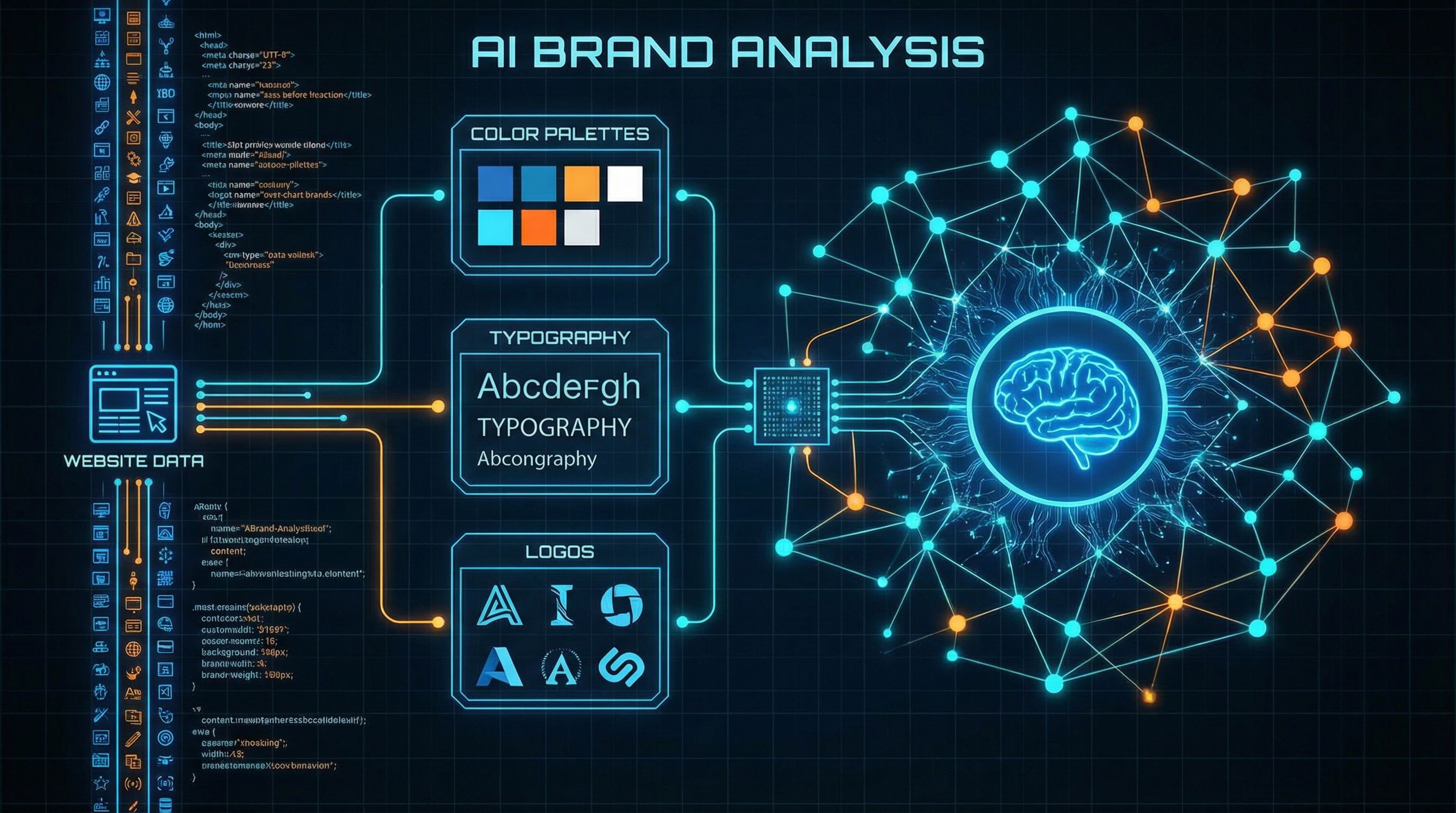
Our brand analysis system consists of five main stages:
Stage 1: Web Crawling & Asset Collection
The journey begins with intelligent web crawling. When you submit a URL, our system:
- Fetches the homepage and identifies key sections
- Discovers additional pages (about, products, contact) through link analysis
- Extracts visual assets: logos, hero images, product photos, icons
- Captures CSS stylesheets and inline styles
- Screenshots key page sections for visual analysis
This typically takes 3-5 seconds and collects 50-200 visual elements for analysis.
Stage 2: Color Extraction
Color is often the most recognizable element of a brand. Our color analysis uses a multi-method approach:
CSS Analysis
We parse stylesheets to identify:
- Explicitly defined brand colors
- Background colors of key elements
- Button and accent colors
- Text colors and their usage frequency
Image Analysis
Using k-means clustering, we analyze images to find:
- Dominant colors in photography
- Common accent colors
- Color temperature tendencies
Weighted Synthesis
Not all colors are equal. We weight our findings based on:
- Element prominence (header vs. footer)
- Usage frequency
- Contrast relationships
- Semantic importance (CTA buttons get priority)
The result: A prioritized palette of 5-8 colors that define your visual brand.
Stage 3: Typography Detection
Typography analysis runs parallel to color extraction:
Font Family Identification
We detect font families through multiple methods:
- CSS font-family declarations
- @font-face definitions
- Common font patterns in rendered text
- Fallback font analysis
Typography Hierarchy
Beyond just identifying fonts, we map the hierarchy:
- Heading levels and their treatments
- Body text characteristics
- Special text styles (captions, quotes)
- Font weight and style variations
Output: A complete typography system including primary/secondary fonts, sizing scales, and weight mappings.
Stage 4: Visual Style Classification
This is where deep learning shines. We've trained custom models on millions of websites to classify visual characteristics:
Style Vectors
Our CNN-based classifier outputs probability scores across dimensions like:
- Modern ←→ Classic
- Minimal ←→ Ornate
- Playful ←→ Serious
- Bold ←→ Subtle
- Warm ←→ Cool
Image Style Analysis
We analyze your imagery for:
- Photography vs. illustration preference
- Image treatment (filters, overlays, effects)
- Composition patterns
- Subject matter tendencies
Stage 5: Brand Personality Synthesis
The final stage combines all signals into a cohesive brand understanding:
The Brand DNA Profile
- Visual identity: Colors, fonts, imagery style
- Personality traits: Derived from visual choices
- Design preferences: Layout tendencies, spacing, element styles
- Recommendations: How to apply this identity to ads
The Models Behind the Magic
Several custom-trained models power this pipeline:
ColorNet
A specialized model for brand color extraction from websites. Trained on 500,000 brand-website pairs, it learns to distinguish intentional brand colors from incidental ones.
FontClassifier
Identifies fonts even when web fonts fail to load, using visual rendering patterns. Achieves 94% accuracy across 1,200 common fonts.
StyleGAN-Brand
A generative model that understands brand aesthetics. Given a brand profile, it can generate new visual elements (backgrounds, patterns, compositions) that match the brand style.
BrandBERT
Our NLP model analyzes website copy to understand:
- Brand voice and tone
- Industry terminology
- Value propositions
- Target audience indicators
This informs copy suggestions in generated banners.
Continuous Learning
The system improves with every interaction:
Feedback Loops
When users select or reject generated banners, this signal flows back to our models. Preferred designs reinforce successful brand interpretations.
A/B Performance Data
We track which brand interpretations lead to better-performing ads, creating a connection between brand analysis accuracy and real-world results.
Manual Corrections
When users override AI decisions (choosing different colors, fonts), we learn from these corrections to improve future analyses.
Accuracy & Edge Cases
Our system works well for most websites, but some cases require special handling:
Multi-Brand Websites
Marketplaces or parent companies with multiple brands trigger our multi-brand detection. We can isolate individual brand identities.
Minimal Websites
Sites with very limited visual content get supplemented with industry-standard patterns and user-provided guidance.
Non-Standard Implementations
Websites using canvas-rendered content or heavy JavaScript frameworks may need our fallback screenshot-based analysis.
Privacy & Security
We take brand data seriously:
- Website content is analyzed in memory and immediately discarded
- Brand profiles are encrypted and stored only in your account
- We never share or sell brand analysis data
- All crawling respects robots.txt and rate limits
What's Next
Our brand analysis continues to evolve:
Competitive Intelligence
Coming soon: analyze competitor brands to identify differentiation opportunities.
Historical Tracking
Monitor how your brand presentation changes over time across your web presence.
Multi-Platform Analysis
Extend analysis beyond websites to social profiles, app stores, and more.
Conclusion
Brand analysis might look like magic, but it's built on solid ML engineering. By combining multiple specialized models with careful pipeline design, we can understand your brand in seconds—and apply that understanding to create perfectly on-brand advertising.
The next time you see your brand colors appear in a generated banner, you'll know the journey those colors took to get there.
Dr. James Lee
Lead ML Engineer
James holds a PhD in Computer Vision from MIT and leads our machine learning infrastructure.